By Prasanth Kumar · September 16, 2026
GPT-6 Astra is positioned by OpenAI as a new generation of AI built not only to answer questions, but to reason through complex tasks, use computers and software, browse the web, and complete multi-step professional work. This article explains Astra in simple terms, its headline benchmarks, computer-use capabilities, practical examples, and the AI infrastructure behind high-density systems such as NVIDIA GB200 NVL72.
In simple terms: traditional AI mainly tells you how to do something. An agentic AI such as Astra is designed to take a goal, work through the steps, use available tools, check results, and produce a finished outcome—within the permissions and environment provided to it.
GPT-6 Astra: Release, Availability and Key Specifications
OpenAI introduced GPT-6 Astra in September 2026. OpenAI says it is rolling out to ChatGPT Plus, Pro, Business and Enterprise users, and is also available through the OpenAI API, Microsoft Azure and Amazon Bedrock. Access and features can vary by plan and product.
- Model: GPT-6 Astra
- API model ID:
gpt-6-astra - Context window: up to 1.05 million tokens
- Maximum output: up to 128,000 tokens
- Reasoning effort: low, medium, high, xhigh and max
- API pricing: $10 per million input tokens and $50 per million output tokens at standard rates
For the latest model specifications and pricing, see the official GPT-6 Astra model documentation and OpenAI’s GPT-6 Astra announcement.
What Makes Astra Different From a Normal Chatbot?
For a non-technical user, the easiest way to understand Astra is to think of it as a move from an AI that answers to an AI that can work through a task.
What Can GPT-6 Astra Do in Everyday Work?
- Computer use: Astra can interact with websites and software through computer-use tools, including clicking, typing, navigating interfaces and completing forms.
- Research: It can browse information, compare sources and prepare structured summaries.
- Documents and presentations: It can create and format documents, spreadsheets and presentations while following provided templates and requirements.
- Software engineering: It can inspect code, make changes, run tests and iterate on problems in supported environments.
- Website and application work: OpenAI says Astra can create websites and web applications and perform frontend quality checks in supported workflows.
- Scientific and technical work: It can work with data and specialized software when the necessary tools are connected.
A Simple Day-to-Day Example
Imagine saying:
“Find out why my website traffic dropped, analyze the data, explain the likely causes, and prepare a report with actions I should take.”
A capable agentic workflow could potentially gather the authorized data, analyze it, compare trends, create charts, write the report and highlight decisions that still require the user’s approval. The important point is that the AI is working through a workflow, rather than simply answering one question.
How Powerful Is Astra for Computer Use?
Computer use is one of Astra’s major areas of improvement. OpenAI reports that Astra can complete tasks such as filling online forms, updating CRM records, organizing calendars, researching information, working in document editors, troubleshooting software and performing frontend QA.
On OpenAI’s reported OSWorld 2.0 evaluation, Astra scored 72.6% on the cited offline test and completed the evaluated tasks in roughly 40 minutes in OpenAI’s latency simulation, compared with about 75 minutes for GPT-5.6 Sol. OpenAI says this represented about 47% less time per task in that simulation.
OpenAI also reports 59.3% on Agents’ Last Exam and 92.7% on ScreenSpot-Pro without tools. These are benchmark results, not a guarantee that every real-world computer task will succeed.
GPT-6 Astra Benchmark Performance
The following figures are OpenAI-reported results. Benchmark methodology, model settings and evaluation environments matter, so scores should not be interpreted as a universal ranking of every possible AI task.
See the OpenAI benchmark and research announcement for the methodology and comparison tables.
Can Astra Build Games and Animations?
Yes, within supported tools and workflows. OpenAI shows Astra working on game development and other visual/interactive tasks. The important distinction is that the AI does not simply produce a text answer about a game—it can work with software tools and files when those tools are available to the workflow.
For example, a user could provide a goal such as:
“Create a simple 30-second animated technology explainer about liquid cooling in AI data centers.”
A complete workflow could involve creating a script, storyboard, visual assets, animation instructions, narration text, captions and an editing plan. The exact ability to generate and render the final video depends on the connected applications and video-generation tools being used.
AI Infrastructure Behind High-Density Computing
Astra is an AI model, while NVIDIA GB200 NVL72 is a physical AI computing platform. They should not be presented as the same product or as proof that Astra specifically runs on one particular rack configuration.
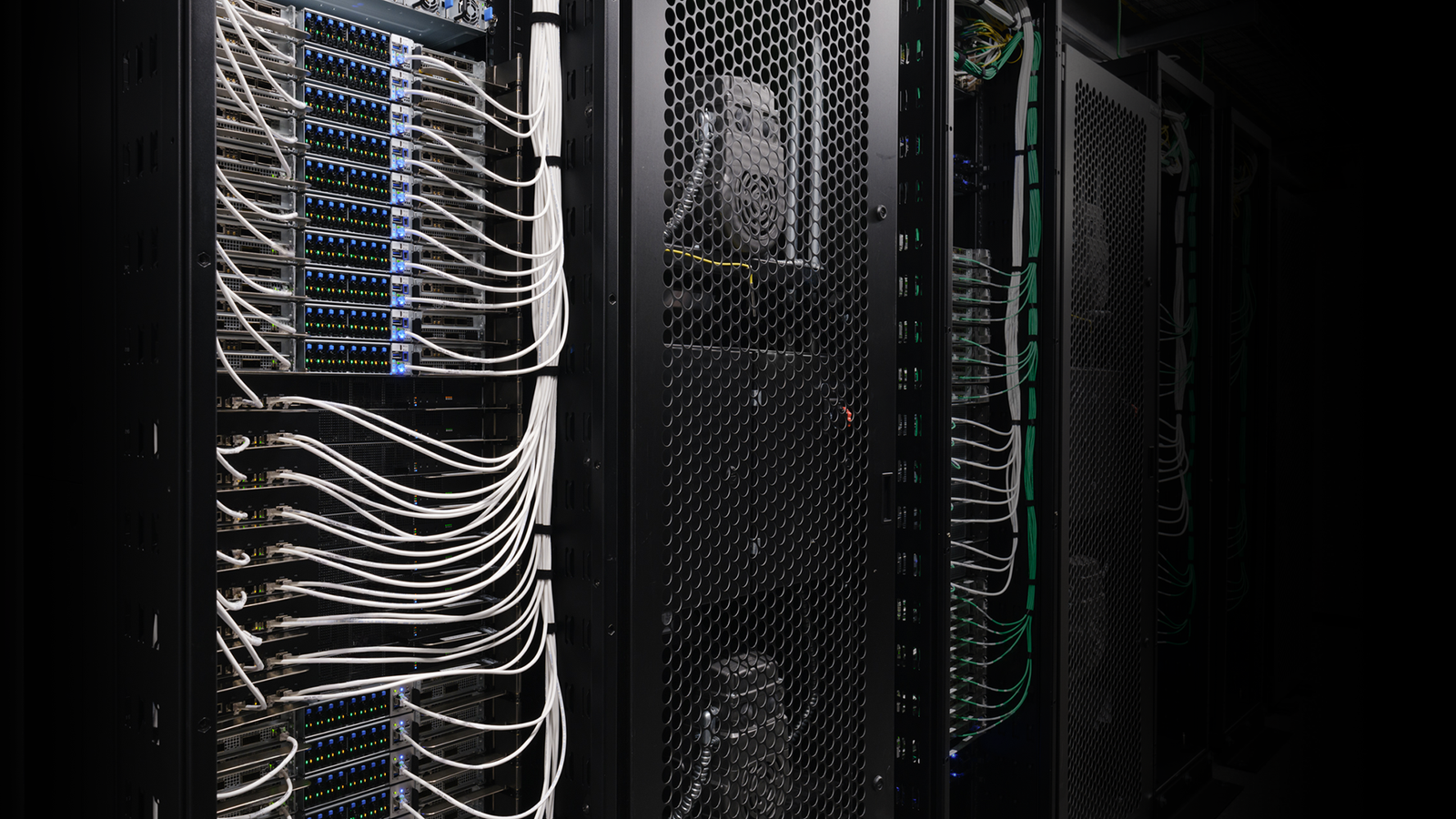
NVIDIA’s GB200 NVL72 is a rack-scale system connecting 36 Grace CPUs and 72 Blackwell GPUs in a single 72-GPU NVLink domain. NVIDIA describes the platform as a liquid-cooled rack-scale design intended for high-performance AI workloads.
See NVIDIA’s official GB200 NVL72 product page for the architecture and specifications.
Direct-to-Chip Liquid Cooling: Why AI Racks Need It
A GB200 NVL72 rack operates at roughly the 120 kW class for a fully configured rack, creating an extremely high thermal-management requirement. NVIDIA documentation also uses a 120 kW designed-rack figure in its Mission Control guidance. The exact power and heat-rejection requirement varies with configuration and workload, so it is better to describe 120 kW as a rack-level design/power figure rather than saying that Astra itself generates 120 kW of heat.
Direct-to-Chip Liquid Cooling Architecture
- Cold plates: Liquid-cooled cold plates are attached directly to the CPUs and GPUs. Heat moves from the processor package into the coolant circulating through the cold plate.
- Rack manifolds: Coolant is distributed through rack-level manifolds and connections to the compute and switch trays.
- Coolant Distribution Unit (CDU): The CDU manages the interface between the rack cooling loop and the facility cooling infrastructure.
- Facility cooling: Heat removed from the rack is transferred to the building’s cooling system rather than relying entirely on room air to remove processor heat.
Simple Cooling Flow
GPU/CPU 🔥 → Cold Plate ❄️ → Coolant 💧 → Rack Manifold → CDU → Facility Cooling → 🔄
Think of it like putting a cooling pipe directly against a very hot surface. Instead of trying to cool the entire room and hoping the heat leaves the chip, the liquid loop collects heat close to the source and carries it away.
Where Claude and Gemini May Have Different Strengths
It is more accurate to describe AI products as having different strengths rather than claiming that one model simply “cannot” do something another model can.
Claude
Anthropic’s Claude family has strong capabilities in long-context work, coding, computer use and agentic workflows. Anthropic says Claude can operate software through computer-use capabilities and that Cowork can handle multi-step knowledge-work tasks. See Anthropic’s Claude Sonnet 5 announcement and Claude Opus 5 information.
Gemini and Project Astra
Google’s Project Astra is a separate Google DeepMind research project and should not be confused with OpenAI’s GPT-6 Astra. Google describes Project Astra as a universal-assistant research prototype with multimodal understanding, screen sharing, real-time interaction, tool use and experiments involving phones and prototype glasses.
Read Google’s official Project Astra page for its current capabilities and availability.
What Astra Still Cannot Guarantee
Agentic AI can be powerful, but it still has important limitations. Here are the key downsides to keep in mind:
GPT-6 Astra in Simple Terms
If someone only knows that “AI is ChatGPT,” the simplest explanation is:
Chatbot AI: “Ask me a question and I will answer.”
Agentic AI: “Give me a goal and, when I have the right tools and permissions, I can work through the steps to accomplish it.”
That shift—from answering to doing—is the most important part of the Astra story.
Useful TechNew Reads
- Latest Tech Trends in 2026: What Is Actually Changing
- Graphics Cards Explained: Choosing the Right GPU
- Refresh Rate Explained: 60Hz vs 90Hz vs 120Hz vs 144Hz
Frequently Asked Questions
Is GPT-6 Astra the same as Google’s Project Astra?
No. GPT-6 Astra is an OpenAI model. Project Astra is Google’s separate AI assistant research project.
Does Astra physically run inside an NVIDIA GB200 NVL72 rack?
NVIDIA’s GB200 NVL72 is an AI computing platform that can support demanding AI workloads. It should not be presented as a specific, exclusive hardware platform for GPT-6 Astra unless OpenAI or NVIDIA explicitly documents that deployment.
Why does direct liquid cooling matter?
High-density AI processors generate far more heat than conventional server racks. Direct-to-chip liquid cooling brings coolant close to the heat source, allowing the rack to remove heat more efficiently than relying on air cooling alone.
Can Astra work like a digital employee?
In supported agentic workflows, it can perform many multi-step tasks using connected tools. However, it still operates within the permissions, safeguards and software environment provided to it and should not be treated as an unrestricted human replacement.
Sources and Further Reading
- OpenAI — GPT-6 Astra: A new generation of intelligence
- OpenAI Developers — GPT-6 Astra model documentation
- NVIDIA — GB200 NVL72
- NVIDIA — GB200/GB300 NVL72 power-budget guidance
- Anthropic — Claude Sonnet 5
- Google DeepMind — Project Astra
Editorial note: AI models, benchmarks, pricing and product features can change quickly. Benchmark figures in this article are identified as OpenAI-reported where applicable and should be checked against the linked primary sources when the article is updated.

Prasanth Kumar is the founder and editor of technew.cloud. He is a technology professional with over 10 years of experience in DevOps, SRE, cloud computing, Kubernetes, Terraform, CI/CD and infrastructure. He writes about smartphones, laptops, graphics cards, gadgets, AI tools, and the technology and products he researches, uses and evaluates. Based in India.