By Prasanth Kumar · September 9, 2026 · updated September 12, 2026
The processor (or “chipset” / “SoC”) is the single component that most decides how fast a phone feels and how long it stays usable. Here is how to read the names without needing benchmarks.
The main brands
- Qualcomm Snapdragon — the most common in Android phones. Strong all round, best-supported for games.
- MediaTek Dimensity — used to be “the budget option”; now competitive at every price, often giving more performance per rupee.
- Samsung Exynos — Samsung’s own chips, used in some of its phones depending on the region.
- Apple A-series — iPhone only; consistently the fastest chips in phones.
- Google Tensor — Pixel only; tuned for Google’s AI and camera features rather than raw speed.
Reading the model numbers
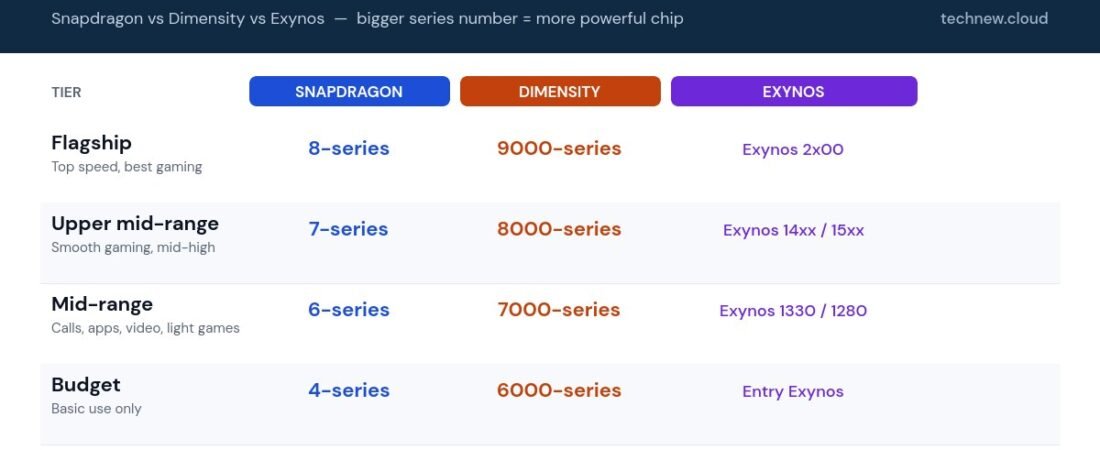
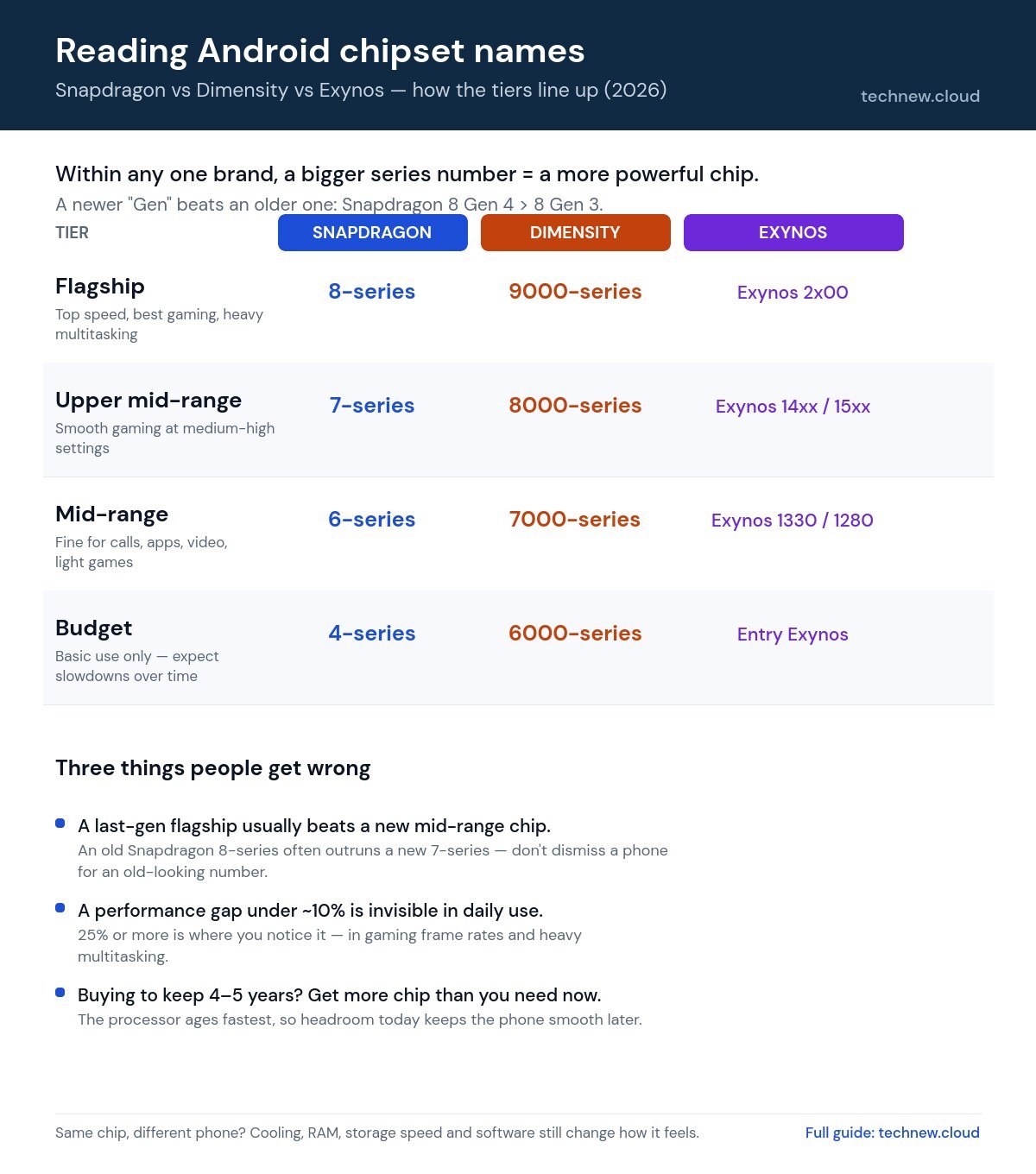
Within a brand, a bigger series number means a more powerful chip:
- Snapdragon: 8-series = flagship, 7-series = upper mid-range, 6-series = mid-range, 4-series = budget. A newer “Gen” is better (8 Gen 3 beats 8 Gen 2).
- Dimensity: 9000-series = flagship, 8000-series = upper mid-range, 7000-series = mid-range, 6000-series = budget.
One catch: a last-generation flagship chip usually beats a current mid-range one. A phone with an older Snapdragon 8-series often outperforms a new phone with a 7-series, so don’t dismiss a model just because the number looks old.
Example phones for each tier (India, September 2026)
The names are easier to place once you tie them to phones you have actually seen. These are current or recent India-market examples — always confirm the exact chip on the retailer’s spec sheet, because brands sometimes change it between storage variants or regions.
| Tier | Qualcomm Snapdragon | MediaTek Dimensity |
|---|---|---|
| Current flagship | Snapdragon 8 Elite Gen 5 — Samsung Galaxy S26 Ultra, OnePlus 15, iQOO 15, OPPO Find X9 Ultra | Dimensity 9500 — OPPO Find X9 and X9 Pro, vivo X300 and X300 Pro, iQOO Neo 11 Ultra |
| Last-generation flagship (still very fast) | Snapdragon 8 Elite — Samsung Galaxy S25 Ultra, OnePlus 13, iQOO 13 | Dimensity 9400 — vivo X200 and X200 Pro |
| Upper mid-range | Snapdragon 7+ Gen 3 — OnePlus Nord 4, realme GT 6T | Dimensity 8400 — POCO X7 Pro, realme GT 7T |
| Mid-range | Snapdragon 7s Gen 3 — Nothing Phone 3a, vivo T4 | Dimensity 7400 — Redmi Note 15 Pro, Motorola Edge 60 Fusion |
| Budget | Snapdragon 6 Gen 3 — Samsung Galaxy A36 | Dimensity 7300 — vivo T4x, OPPO Reno16C |
Where Samsung Exynos fits
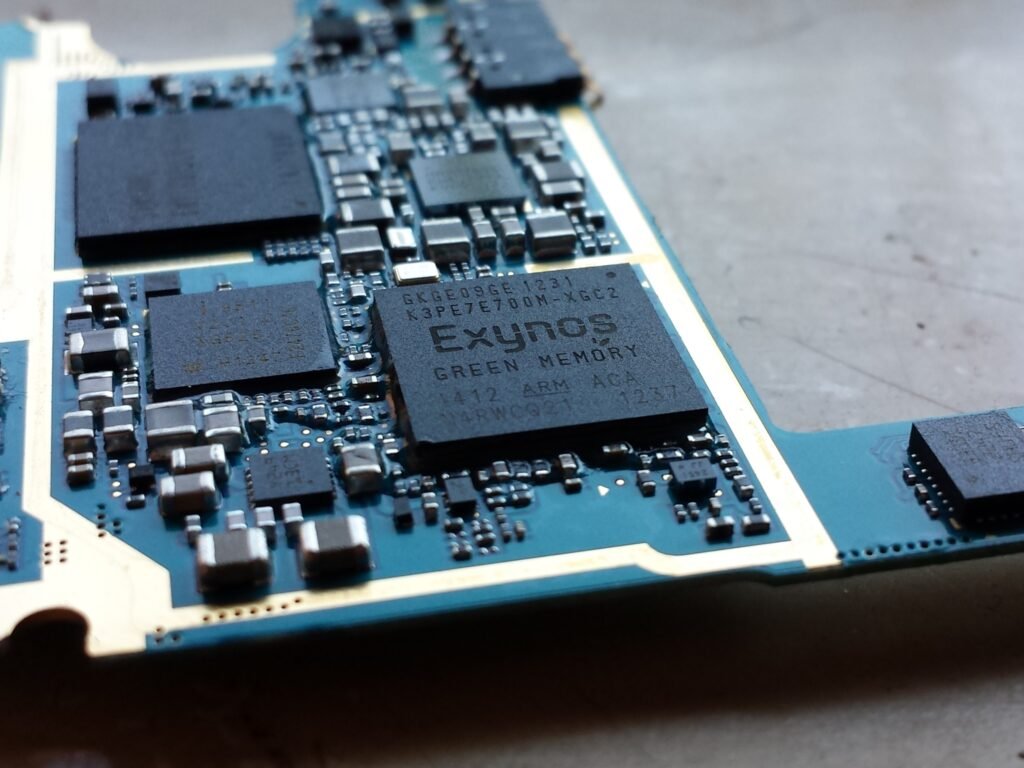
Exynos chips appear only in Samsung phones, and Samsung now keeps them out of its top “Ultra” models — the Galaxy S25 Ultra and S26 Ultra use Snapdragon worldwide. Exynos currently sits in Samsung’s cheaper flagship and mid-range Galaxy phones:
- Exynos 2400 (flagship-class) — Samsung Galaxy S24 and S24+, Galaxy S25 FE
- Exynos 1580 (mid-range) — Samsung Galaxy A56
- Exynos 1380 (older mid-range) — Samsung Galaxy A54, Galaxy A35
Where a phone has been sold in both Snapdragon and Exynos versions, the Exynos one has tended to give slightly lower gaming performance and battery efficiency; for calls, browsing and video the two feel much the same.
How much does the chip actually matter?
- For calls, messaging, browsing, video: almost any current 6-series or better is smooth. Don’t overpay for performance you won’t use.
- For gaming: this is where it counts. A 7-series or better handles popular titles at medium-high settings; serious gamers want an 8-series / 9000-series with a vapour-chamber cooling system.
- For keeping the phone 4-5 years: buy more chip than you need today. The processor ages fastest, so headroom now means the phone stays smooth longer.
FAQ
Is Snapdragon better than Dimensity?
Not automatically. At the same price they are usually close; Dimensity often edges ahead on raw performance, Snapdragon tends to have better game optimisation and efficiency. Compare the specific models, not the brands.
How do I find out which chip a phone has?
It is listed on the retailer’s spec sheet under “Processor” or “Chipset”. If a listing hides it, that is usually a sign the chip is weak for the price.
Do more CPU cores mean a faster phone?
No. Core count and clock speed on their own tell you little — chip architecture and manufacturing process matter more. Use the series tier (8/7/6) and generation as your guide.
More in Tech Explained. See the chips in context in our phone buying guides.
A quick way to rank two phones by chip
- Note each phone’s chipset from the spec sheet.
- Search “[chip A] vs [chip B]” — sites like Nanoreview and Geekbench list a clear score and a percentage gap.
- A gap under ~10% will not be noticeable in everyday use. A gap of 25% or more shows up in gaming frame rates and heavy multitasking.
- Also check the manufacturing process (e.g. “4nm”, “6nm”) — a smaller number generally means better efficiency and less heat for the same performance.
Why the same chip can perform differently in two phones
A chipset is only part of the story. Two phones with the identical processor can feel different because of cooling (a vapour chamber lets the chip run at full speed for longer before throttling), RAM type and amount, storage speed (UFS 3.1/4.0 versus older eMMC), and software optimisation. This is why reading a review of the specific phone still matters even after you have compared the chips.
Is an iPhone chip really faster than Android chips?
In raw benchmark terms Apple’s A-series chips have led for several years, especially on single-core performance and sustained gaming. For everyday tasks the best Android flagships feel just as fast; the gap is most visible in demanding games and pro video editing.
What is an NPU or “AI engine”?
A dedicated part of the chip for machine-learning tasks — on-device photo processing, voice recognition, live translation and the newer on-device AI features. A stronger NPU matters more each year as phones move AI work off the cloud.

Prasanth Kumar is the founder and editor of technew.cloud. He is a technology professional with over 10 years of experience in DevOps, SRE, cloud computing, Kubernetes, Terraform, CI/CD and infrastructure. He writes about smartphones, laptops, graphics cards, gadgets, AI tools, and the technology and products he researches, uses and evaluates. Based in India.